Intelligent ingestion + experimentation / QA
AppyHour Scraper
Turning unstructured venue data into a measurable, human-reviewed ingestion pipeline.
- Engagement
- Research + ingestion system
- MVP boundary
- HTML-first
- Quality
- Automated grading + human review
- Target
- Overnight market enrichment
Thirty-second read
Problem
Venue offers and events were costly to gather at market scale.
Owned
Coverage research, MVP boundary, pipeline, and quality model.
Key decision
HTML-first
Proof
~95% lower API cost and 70–80% fewer tokens.
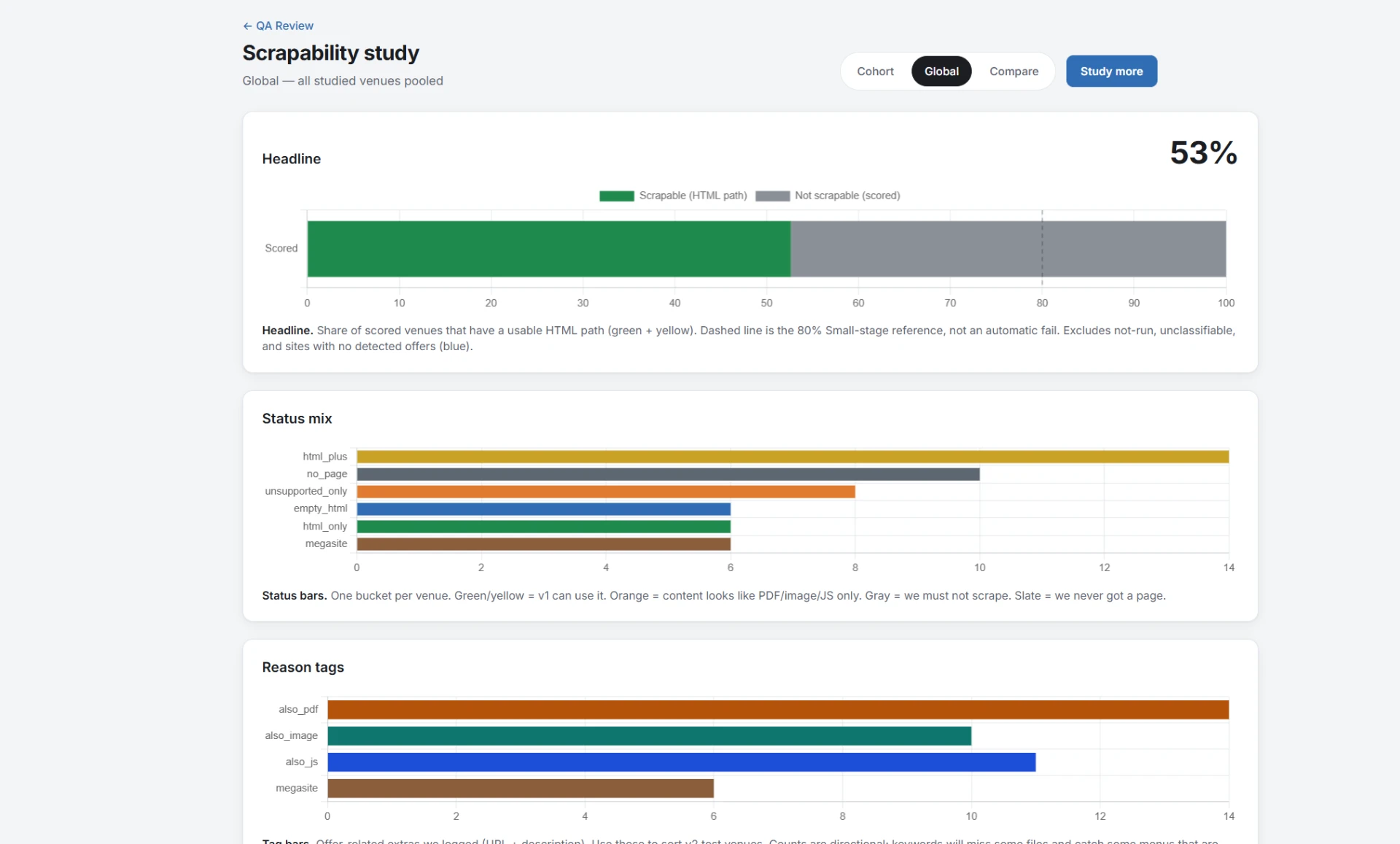
53%
Usable HTML path
Of scored venues in the studied pooled sample
~95%
Lower API cost
After extraction optimization
70–80%
Fewer tokens
Supporting overnight enrichment
01 / Context
Problem / opportunity
Offers and events lived across inconsistent pages and formats. Manual collection—and undifferentiated extraction—was too expensive to scale.
The first decision was not how to scrape everything. It was what an evidence-based v1 should cover.
53% refers only to scored venues in the studied pooled sample—not the whole web.
Before scaling extraction, I used stratified random sampling to measure what an HTML-first MVP could realistically cover. That evidence shaped the product boundary: HTML became the v1 path, while PDF, image, and JavaScript-heavy sources were measured and deliberately deferred.
02 / Ownership
What I owned
- 01Designed a stratified random study to measure realistic HTML coverage.
- 02Set the HTML-first v1 boundary and documented deferred source types.
- 03Designed the ingestion, grading, normalization, validation, and sync pipeline.
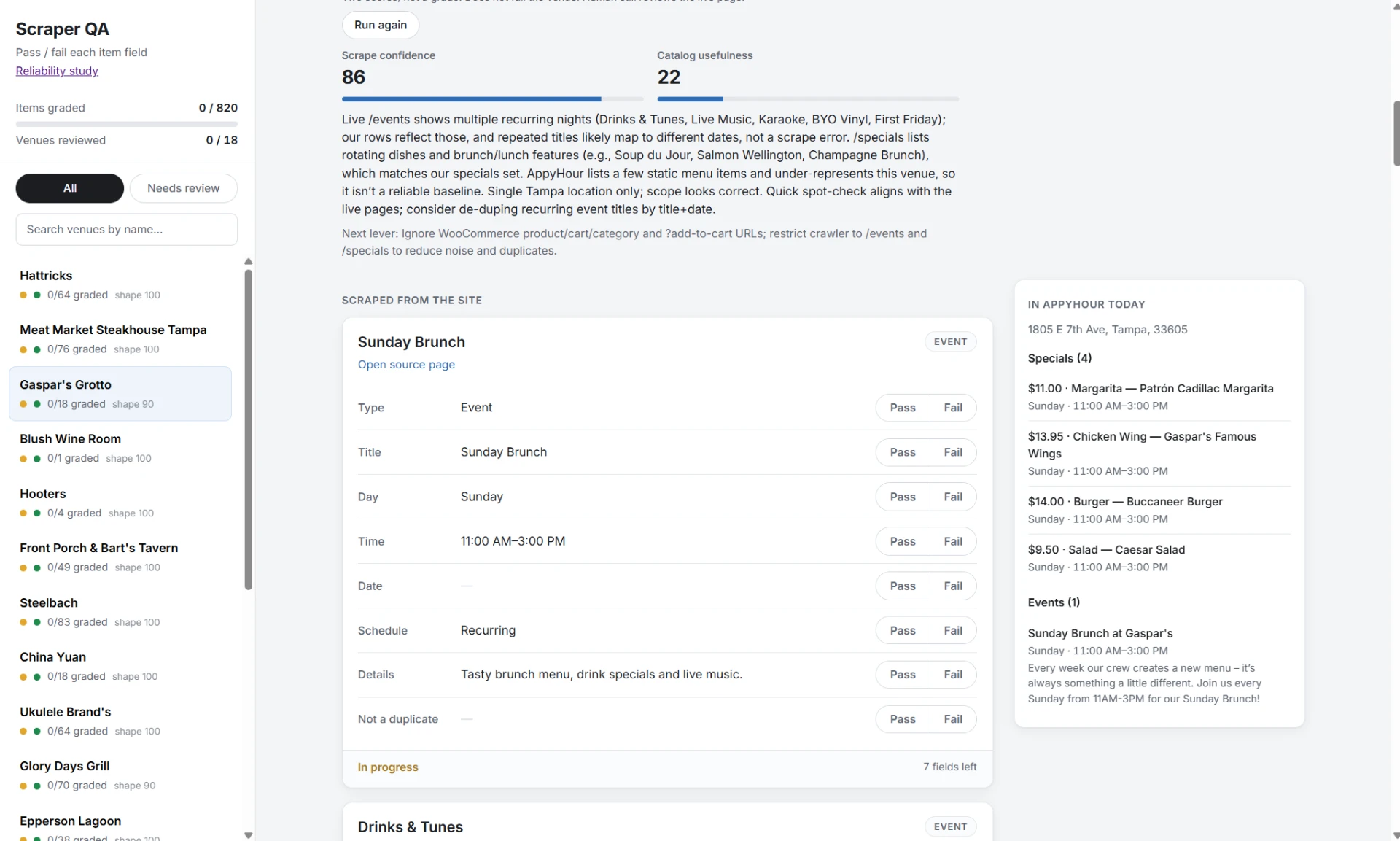
- 04Kept human review in control while AI explained count disagreement on demand.
03 / System
System / product architecture
- 01
Discover
- 02
Crawl
- 03
Clean
- 04
Extract
- 05
Grade
- 06
Normalize
- 07
Validate
- 08
Sync
- 09
Mobile
A staged pipeline converts uncertain source material into reviewed, mobile-ready catalog data.
Scrape confidence measures extraction reliability; catalog usefulness measures product value.
Human reviewers make quality decisions. AI tuning notes explain disagreement but never decide pass/fail.
Extraction and prompt changes cut API cost by approximately 95% and token use by 70–80%.
04 / Evidence
Product evidence
05 / Outcome
What changed
The study turned technical uncertainty into a measurable product decision.
A deliberately constrained v1, explicit expansion paths, and lower extraction costs created a practical route to overnight market enrichment.
Let's discover what's possible.
Every business has hidden opportunities.
Some require better decisions. Some require automation. Some require entirely new software.
Let's find yours.